How much does a house in Granby actually cost right now? Ask that question to four different sources and you will get four different answers, and not by a rounding error. One site's own numbers put Granby's median home price at $474,000 in December 2025 and $562,000 five months later in May 2026. Another source, working from a trailing twelve months of closed sales, lands at $425,000. A fourth, watching current listings only, shows $500,000. That is a spread of $137,000 on a single median for a single town, sometimes from the same website comparing two dates only months apart.
If you are comparing Granby to Simsbury, Avon, or Canton on price alone, that spread should stop you. A median this unstable is not describing a housing market shifting under your feet. It is describing a market with too few transactions for a single number to mean much of anything.
Why one number can't hold still
Granby covers 40.7 square miles and is home to roughly 11,300 residents, according to the town's own assessor records. One recent count put trailing twelve-month home sales at 115, with only 9 active listings on the market at the time of that snapshot and an average of 38 days to sell. Compare that to a denser neighboring market with far more annual closings, and the mechanism becomes obvious. When 115 sales are spread across a town this size, a single month with three luxury estate closings on Day Street or four starter ranches near the village center can drag the median tens of thousands of dollars in either direction. That is not appreciation or depreciation. It is sample size.
This is why the same tracking site can report a median of $474,000 in one quarter and $562,000 in the next without the underlying market having actually repriced by that much. The mix of what happened to close changed. The town did not.
The two Granbys the median flattens
Part of what a town-wide number hides is that Granby is not one housing market. It is at least two, separated less by distance than by zoning.
Around Salmon Brook Street, the village center reads like a small New England downtown. The Salmon Brook Shops building houses roughly 30 antique dealers under one roof, a short walk from Old Mill Pond Village Shops and the Cambridge House Brew Pub. A Stop & Shop anchors daily errands. Lots here tend to be smaller and older, many with municipal water and sewer, sitting near South Congregational Church and Salmon Brook Park, a former golf course dating to the 1920s.
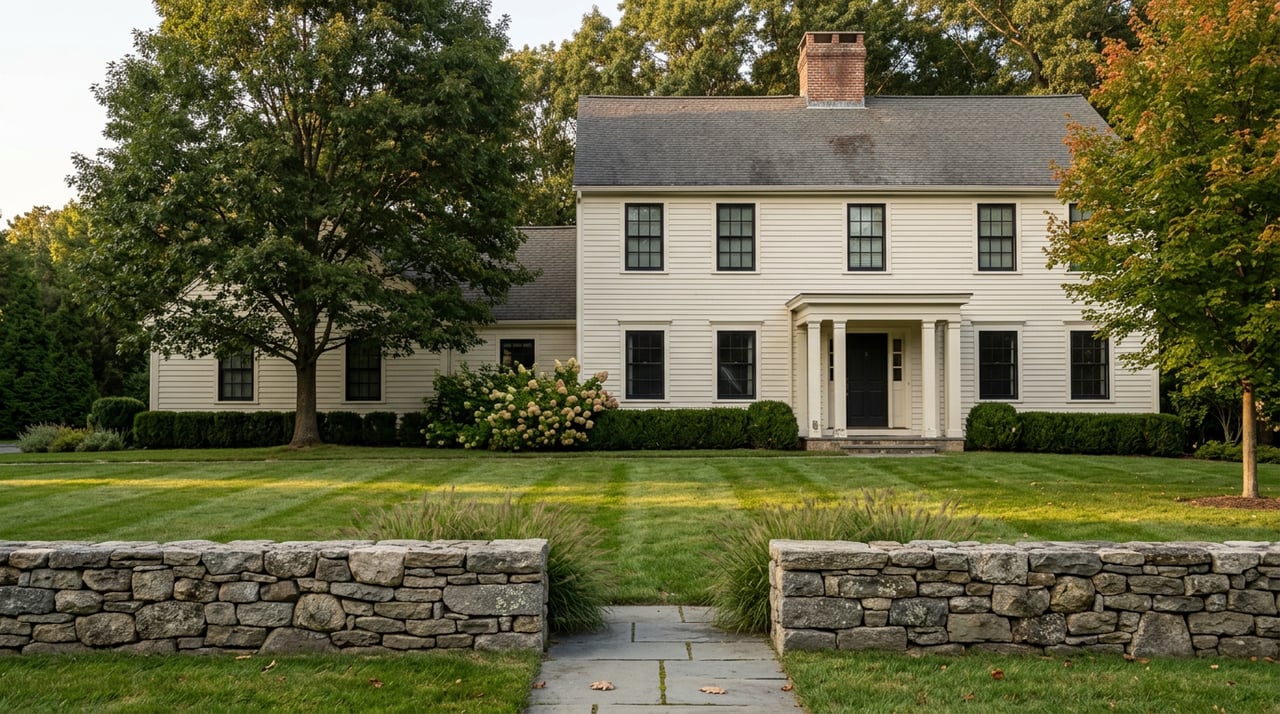
Head north or west and the zoning changes the math entirely. Planning and zoning records show properties in Granby's R2A district running 4.8 and 7.5 acres, a designation that pairs with private well and septic systems rather than town utilities. A short distance away, a 15.63-acre parcel along Day Street and North Granby Road carries the R30/R50 designation instead, the same zoning behind several of the town's newer rural subdivisions. Recent listings out of North Granby describe a home on 2.02 acres with stone walls and perennial gardens and a Cape Cod-style property on 5.86 acres at the end of a cul-de-sac. Further west, the town's rural character shows up in Enders State Forest and Enders Falls, The Garlic Farm's seasonal stand, and the pair of Lost Acres properties, an orchard restaurant and bakery on one side of the road and a café, bakery, and vineyard on the other.
Buying two acres with a well and a septic field is a different financial commitment than buying a quarter acre on town water, even at an identical price point. A town-wide median cannot tell you which one you are actually comparing.
New supply is entering at the edges, not the center
Two subdivisions currently moving through Granby's approval process will add standardized inventory precisely to the outer, larger-lot zones that already skew the median. Breezy Meadow, a 7-lot subdivision at 188 Day Street in the R30 and R50 zones, cleared the town's Planning and Zoning Commission in November 2025 with an expanded streetscape buffer and a revised planting plan for the rear lots. Cider Mill Heights, a 10-lot flexible residential development, received a 90-day filing extension from the Planning and Zoning Commission in September 2024.
When even a handful of new-construction lots close in a town this size, they can pull the median in a direction that has nothing to do with how existing homes are appreciating. A buyer watching the headline number move should ask whether new supply, not organic demand, is doing the moving.
The tax bill your median can't show you
The number that actually determines your monthly cost of ownership in Granby is not the median sale price. It is the mill rate applied to your specific parcel's assessed value, and that number had its own dramatic year.
Granby's Board of Finance opened its FY2026-27 budget season with a proposed spending increase of 3.20%. Voters said no. The first referendum, held May 4, 2026, failed by a vote of 1,262 to 1,116. The town went back to the budget and found $900,000 in direct property tax relief: $650,000 in combined expense cuts split between the municipal and Board of Education sides, another $200,000 in additional state aid, and a $50,000 reserve draw. The revised budget passed at a second referendum on May 18 by a vote of 1,425 to 1,025, and it carried a mill rate increase of just 0.76%.
First referendum, May 4, 2026: rejected, 1,262 to 1,116. Second referendum, May 18, 2026: approved, 1,425 to 1,025.
The result, effective July 1, 2026, is a real estate mill rate of $34.47 per $1,000 of net assessed value, according to the Granby Assessor's office. That number was not settled until a month after the fiscal year most buyers assume it governs had already begun.
There is a second, quieter mechanism layered underneath that rate. Granby's current revaluation is effective October 1, 2022, and the next one is not scheduled until October 1, 2027. Every assessed value feeding this year's tax bills reflects market conditions from nearly four years ago, not the price a home would fetch if listed today. For a buyer, that means the carrying cost on a home that has appreciated meaningfully since 2022 is still being calculated off a lower, older base, at least until 2027 arrives and the town's assessments catch up. Based on how the 2022 cycle played out, with new assessments mailed that November and a new mill rate not finalized until the following summer, the actual tax impact of the 2027 revaluation likely will not be fully priced in until sometime in 2028.
What to compare instead of the median
If you are weighing Granby against other Farmington Valley towns, a single headline price is the least useful number available to you. A more honest comparison looks at:
- Recent closed sales within the specific village or zone you are considering, not the town as a whole
- Whether the property sits on private well and septic, common in the R2A district, or on municipal water and sewer, more typical near Salmon Brook Street
- The parcel's current assessed value against its likely resale price, given that assessments are frozen until the 2027 revaluation
- Whether nearby new-construction activity, like the lots at Breezy Meadow, might be temporarily skewing the area's median
None of that shows up in a single scraped number. It shows up in the kind of comparison a local advisor builds by hand, parcel by parcel, using the same public records referenced above rather than a single site's rolling average.
FAQ
Is Granby's housing market currently slowing down or speeding up? Depends entirely on which window and source you use, which is the point of this piece. One tracking site's May 2026 snapshot showed price per square foot down 10% year over year alongside faster turnover, a median of 13 days on market. A different source's trailing twelve-month figure showed prices up 6% with a slower 38-day average. Both can be true at once in a market this thin.
Why does it matter whether a home has private well and septic? Beyond the obvious maintenance responsibility, well and septic systems change the inspection scope, the financing conversation with some lenders, and the long-term cost of ownership in ways municipal water and sewer do not. It is one of the clearest practical differences between Granby's village center and its outer zones, and it rarely shows up in a listing's headline price.
When will Granby's property tax assessments reflect current market values? Not until the next scheduled revaluation effective October 1, 2027, and likely not fully reflected in an actual mill rate until roughly a year after that, based on the pattern from the 2022 cycle.
Working with someone who tracks the parcel, not just the headline
A median is a starting point for a conversation, not the conversation itself, especially in a town where 115 annual sales are asked to represent an entire market. If you are comparing Granby against Avon, Simsbury, or West Hartford and want the comparison built on actual parcels, actual zoning, and actual assessed values rather than a rolling average from a national site, Ellen Sebastian and The Sebastian Group have spent more than three decades working these exact towns. Let's Connect, and we will walk through what your specific price range actually buys in each part of Granby before you make a decision based on a number that may not hold still long enough to matter.